
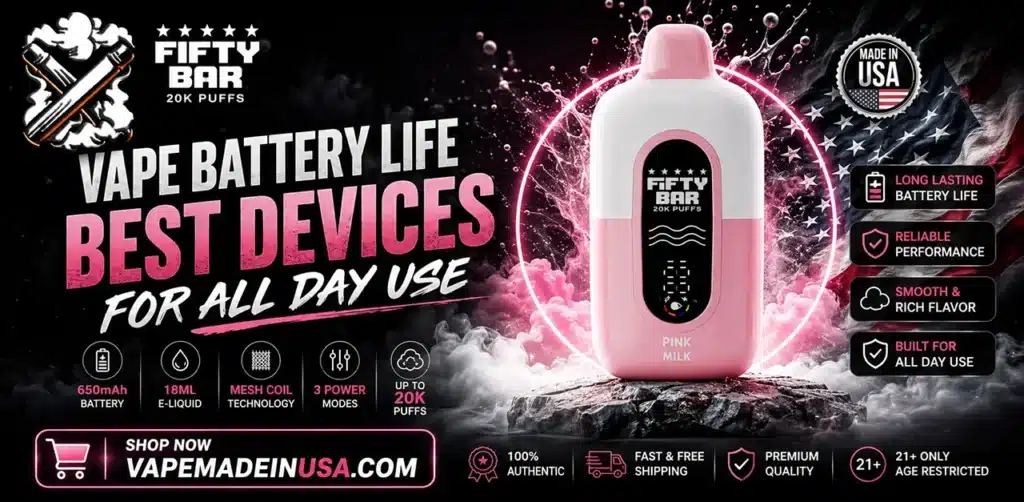
The disposable vapes with the longest all-day battery life are large-capacity devices like the Boulder Diamond Bar (51,000 puffs) and Fifty Bar-based collaborations (6,500–20,000 puffs), which pair high-capacity built-in batteries with efficient mesh coils so the charge outlasts the e-liquid. For most all-day vapers, a device rated above 6,500 puffs with a 500mAh+ battery will comfortably last a full day of regular use without dying before the juice runs out.
Battery life is one of the most overlooked specs when people shop for a disposable vape. Flavor gets all the attention, but nothing ruins a vaping experience faster than a device that dies halfway through the day while there’s still e-liquid left inside. If you’ve ever felt your device get warm, produce weaker hits by the afternoon, or stop firing completely before the pod ran dry, the battery – not the coil or the juice – was almost certainly the problem.
This guide breaks down exactly how vape batteries work, what separates a device that lasts all day from one that quits by lunchtime, and which specific devices are actually built for long, uninterrupted use. Everything here is based on how draw-activated disposable vape hardware is engineered and how battery capacity, puff count, and coil resistance interact in real-world use.
What is Vape Battery Life?
Vape battery life refers to how long the built-in battery inside a disposable device can power the heating coil before it needs recharging (on rechargeable models) or before the device is finished (on standard disposables). It’s measured differently than a phone battery. Instead of “hours of use,” vape battery life is usually expressed as puff count — the number of individual draws the device is designed to deliver before either the battery or the e-liquid runs out, whichever comes first.
This distinction matters. A device advertised at 20,000 puffs isn’t guaranteeing 20,000 puffs of battery power — it’s an estimate based on a fixed e-liquid volume and an average draw length (usually 1–1.5 seconds per puff). The battery has to be sized correctly to match that estimate, or the device will die with juice still left in the tank, which is the single biggest complaint vapers have about cheaply made disposables.
How Disposable Vape Batteries Actually Work
Every disposable vape runs on a small lithium-ion or lithium-polymer battery, typically ranging from 400mAh in compact devices up to 850mAh or higher in large-capacity models like 50,000-puff devices. When you draw on the device, an airflow sensor triggers the battery to send power to the coil, which heats the e-liquid into vapor. This is called draw-activation, and it’s the standard across nearly all modern disposables — there’s no button to press.
The battery has one job: deliver consistent power to the coil for every single puff, from the first draw to the last. Cheaper devices use lower-grade cells that lose voltage output as they drain, which is why the vapor gets noticeably weaker toward the end of the device’s life. Better-engineered devices use regulated chipsets that maintain steady voltage output across the full discharge curve, so puff 50 feels roughly the same as puff 5,000.
Mesh coils, which most quality disposables now use instead of older single-strand coils, also play a role here. Mesh coils heat more evenly and require slightly less power to vaporize the same amount of liquid, which stretches battery life further without sacrificing flavor or cloud production.
Puff Count vs. Battery Capacity: How They’re Matched
| Device Type | Typical Puff Count | Typical Battery Size | Realistic All-Day Use? |
| Compact disposable | 600–1,500 puffs | 280–400mAh | Short trips, not full-day |
| Mid-size disposable | 5,000–6,500 puffs | 400–550mAh | Yes, for average users |
| High-capacity disposable | 15,000–20,000 puffs | 600–750mAh | Yes, multi-day for most users |
| Ultra-capacity disposable | 40,000–51,000 puffs | 800mAh+ | Yes, easily multi-day |
The takeaway: puff count alone doesn’t tell you if a device will last all day. A 20,000-puff device with an undersized battery can still die early. What matters is whether the manufacturer scaled the battery capacity to match the e-liquid volume and puff estimate — which is exactly why brand reputation and build quality matter more than the number printed on the box.
Best Devices for All-Day Battery Life
Based on how these devices are engineered — battery capacity relative to puff count, coil type, and real-world discharge consistency — here are the categories of disposables best suited for people who need a device to last through a full day without dying early.
High-capacity 6,500-puff devices are the sweet spot for most all-day vapers. They’re small enough to carry comfortably but carry enough battery capacity to outlast a typical day of moderate use — roughly 100–150 puffs spread across 12–16 hours. Devices in this range are built with regulated output chips specifically so the last third of the device doesn’t feel noticeably weaker than the first.
20,000-puff collaboration devices (the kind built through partnerships between flavor houses and hardware brands) step up both the e-liquid reservoir and the battery size proportionally. These are aimed at heavier users or people who want a device that comfortably spans several days without a mid-week battery scare. The larger battery cells in this category also tend to hold voltage more consistently, which keeps flavor and vapor production stable much longer.
Ultra-capacity 51,000-puff devices sit at the top end of the market. These use the largest battery cells available in disposable form factor, paired with dual mesh coils in some models to keep power draw efficient. For someone who vapes frequently throughout the day, this class of device is built to outlast weeks of regular use rather than just a single day.
The common thread across all of these: the device’s battery was clearly sized to match its puff rating, rather than the puff number being an inflated marketing figure sitting on top of an undersized cell.
Factors That Actually Affect Battery Life
Several things influence how long a disposable vape’s battery lasts in real-world conditions, beyond just the mAh rating printed on the packaging:
Draw length and frequency: Longer, harder draws pull more power per puff than short, gentle ones. Someone taking 3-second draws will drain a battery significantly faster than someone taking quick 1-second puffs, even on the same device.
Coil resistance: Lower-resistance coils heat faster but draw more current, which can shorten battery life even if they produce bigger clouds. Higher-resistance mesh coils tend to be more battery-efficient over the life of the device.
Temperature: Lithium batteries lose efficiency in cold weather. A device carried in a cold car or left outside in winter will show reduced battery performance until it warms back up to room temperature.
E-liquid viscosity: Thicker e-liquids require more heat (and therefore more power) to vaporize properly, which can add extra strain on the battery over the device’s full lifespan.
Manufacturing consistency: This is the biggest variable and the hardest for a consumer to judge upfront. Reputable brands test battery discharge curves against their puff count claims; less reputable manufacturers sometimes don’t, which is why two devices with identical puff ratings can perform very differently in practice.
How to Extend Your Device’s Battery Life
While you can’t recharge most standard disposables, there are practical habits that help you get the full puff count out of the battery you have:
- Take shorter, steadier draws instead of long, hard pulls. This reduces power draw per puff and helps the battery last through the full e-liquid supply.
- Store the device at room temperature. Avoid leaving it in a hot car, direct sunlight, or freezing conditions, all of which stress the internal battery chemistry.
- Avoid chain-puffing. Taking draws back-to-back without pauses causes the coil (and battery) to heat up rapidly, which can trigger safety cutoffs on some devices and accelerates wear.
- Keep the mouthpiece clear. A clogged airflow path can cause the sensor to work harder to detect a draw, subtly increasing power draw over time.
- Use rechargeable models fully before topping up, if your device has a USB-C port. Partial, frequent charging cycles on lithium batteries are generally less efficient than letting the charge run down further before recharging.
Signs Your Vape Battery Is Dying
Recognizing early warning signs helps you plan ahead rather than being caught without a working device mid-day:
- Vapor production noticeably weaker than when the device was new
- Flavor tasting flatter or more muted, even with e-liquid clearly still present
- The device flashing a light (on models equipped with an LED indicator) after each draw
- Needing to draw harder or longer to get the same amount of vapor
- The device warming up faster than usual during normal use
If you notice several of these signs while there’s still visible e-liquid in the tank, it’s the battery reaching the end of its cycle, not the coil or the juice.
Rechargeable vs. Non-Rechargeable Disposables
Some higher-capacity disposables now include a USB-C charging port, technically making them “rechargeable disposables” — a hybrid category that’s grown quickly as puff counts have climbed into the tens of thousands. On these devices, the battery is designed to be recharged once or twice near the end of the e-liquid supply, ensuring the last portion of juice doesn’t go to waste because the battery died first. Standard non-rechargeable disposables, by contrast, are built with a fixed battery sized to (ideally) last exactly as long as the e-liquid does, with no way to top it up.
For someone specifically shopping for all-day reliability, a rechargeable disposable offers a safety net: if the battery does run low before the tank does, a quick top-up solves the problem instead of forcing you to throw away a device with usable e-liquid still inside.
Expert Insight
People who vape daily and pay close attention to hardware quality generally agree on one thing: puff count printed on the box is only useful when it’s backed by a battery built to match it. A disposable rated for 20,000 puffs with a weak or undersized cell inside will not outperform a well-engineered 6,500-puff device in terms of consistent, all-day performance. When evaluating a device for all-day use, battery capacity relative to puff rating is a far more reliable indicator than the puff number alone.
FAQs
How many puffs should a disposable vape last per day for average use?
Most moderate users take somewhere between 100 and 150 puffs per day. A device rated at 6,500 puffs or higher will typically cover several days of average use before the battery or e-liquid runs out.
Why does my vape die before the e-liquid runs out?
This usually happens when the built-in battery is undersized relative to the puff count the device is rated for. It’s a common issue with lower-quality disposables where the battery wasn’t scaled to match the e-liquid volume.
Do bigger puff counts always mean longer battery life?
Not necessarily. A higher puff count only translates to longer battery life if the manufacturer paired it with a proportionally larger battery. Some devices inflate puff numbers without upgrading the internal cell.
Can cold weather affect my vape’s battery?
Yes. Lithium batteries lose efficiency in cold temperatures, which can temporarily reduce vapor production and battery output until the device returns to room temperature.